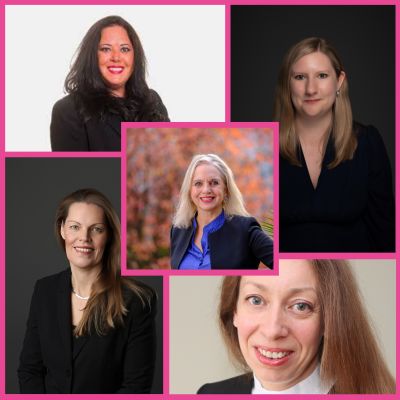
This International Women's Day, Bar leaders share what they hope to see change for women at the Bar in the next decade, what they would do differently if they were starting their career today and much more.
Kirsty Brimelow KC (centre) is Chair of the Bar Council. Heidi Stonecliffe KC (bottom right) is Vice Chair of the Bar Council. Claire Davies KC (bottom left) is leader of the South Eastern Circuit. Samantha Hillas KC (top left) is leader of the Northern Circuit. Amelia Clegg (top right) is Chair of the Bar Council's Young Barristers' Committee.
What does this year’s International Women’s Day theme ‘give to gain’ mean to you?
Kirsty: “‘Give to gain’ is the hand outstretched to women and the steps on the ladder that is kept down. The more spaces that are opened for women to lead, the more strength is built into the world. Inclusive leadership is a powerful driver of innovation and progress.”
Claire: “To me ‘Give to Gain’ means recognising the support offered by others to women in the profession which only enriches the profession. Leading to the profession being more inclusive and enabling women to be supported and achieve in their careers.”
Samantha: “Volunteering isn't all one way. The roles I take on beyond the day job have provided me with opportunities to meet some fantastic people and become involved in really interesting projects.”
Heidi: “To me, ‘Give to Gain’ means recognising and reflecting on how others have supported me and lifted me up and choosing to do the same, to pay it forward and to keep a hand outstretched for those starting out or taking the next steps in their careers. By sharing support, encouragement, and opportunity, by being visible as advocates for change, we enable progress that might not be possible to achieve alone. My support first came from my parents, particularly my wonderful dad who took me to the Old Bailey to watch cases when at 16 I said, ‘I want to be a barrister’. He lit the fire very early on!”
What’s the best piece of advice you’ve been given while working at the Bar?
Samantha: “Even if you’re up against it, make sure you get at least 4 hours’ sleep.”
Kirsty: “I have had so many good pieces of advice from my friends and colleagues over the decades. But it is actions of kindness that I remember most and particularly during my time leading the struggle of legal aid barristers at the criminal Bar. The kind words were my support. When I started going to court, the best advice was to make friends with the court staff. I remember that the listing officer at St. Alban’s Crown Court came to my 40th birthday, such was my closeness!”
Amelia: “Courtesy of my grandmother, ‘good manners cost nothing’, and ‘be on time to meetings’. Politeness and punctuality might not be flashy qualities, but you definitely notice when people don’t have them!”
What would you do differently if you were starting your career today?
Samantha: “Find a mentor. I wasted a lot of time trying to figure stuff out for myself. That’s no bad thing, but the support and guidance of someone more senior would have been welcomed.”
Amelia: “I have always trusted my gut when making career decisions and I think I’d continue to do that if I started today!”
Kirsty: “I would have more confidence in my abilities. That came later and was thanks to a senior barrister who discussed a case with me and analysed that my judgement was good and so I could rely on myself. I also would have looked harder for career advice at the Bar, including international opportunities.”
Heidi: “Honestly, I wouldn’t change anything. Every challenge and opportunity has shaped who I am. I’d rather look forward, using the lessons I’ve learned than rewrite the experiences that shaped me. As Ruth Bader Ginsburg said, ‘Things you regard as an impediment can turn out to be great, good fortune.’ The hurdles that seemed insurmountable to me at the time, built resilience, a determination to get it done and a drive to make sure others have the opportunity and support to be the very best they can be.”
What has changed for women at the Bar since you became a pupil?
Kirsty: “When I started at the Bar, women were not allowed to wear trousers. I remember laddered tights from rough benches in courts and prisons. And so wearing trousers felt like a milestone in 1995! Human rights law was not an area of law when I started practice. Now there are many more opportunities for young barristers in international work, and I have enjoyed stitching travel with law.”
What do you hope to see change for women at the Bar in the next 10 years?
Heidi: “My ideal would be to see real, tangible change: robust childcare support, genuinely fair briefing practices across the profession, and sustained investment in returners including mentoring, advocacy support and career coaching - ensuring women at the Bar not only stay but thrive and lead.”
Amelia: “I’d like to see the percentage of female King’s Counsel get closer to 50% than it currently is.”
Claire: “I hope to see the eradication of the gender pay gap, an increase in support for mothers returning to work and an increase in the number of women appointed in senior positions within the profession.”
Kirsty: “When I was interviewed for pupillage and tenancy, I frequently would be asked whether I planned to have children. We have made so much progress since those days, but in 10 years’ time each chambers should be showing why they are the best work places for women wishing to start a family.
“Women also remain underrepresented in commercial and chancery law and also are scarce in the Supreme Court. A significant change would be for instructions to go to women at the Bar in these areas. I hope that this doesn’t take 10 years!
“Finally, conflict resolution in international law should appoint more women. After all, what an excellent side effect of change at the Bar if the world stepped back from its own destruction.”