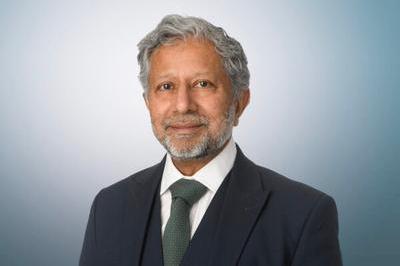
In August we were delighted to co-host the first ever International Legal Symposium organised by the Bar Association of Sri Lanka and the Bar Council of England and Wales. In this guest blog, barrister Sailesh Mehta extols the many benefits of working with colleagues abroad.
From Friday 7 to Sunday 9 August 2026, I was pleased to join the Bar Council delegation to Colombo for the inaugural International Legal Symposium organised by the Bar Association of Sri Lanka (BASL). The event was the first joint conference between the Bar of England and Wales and BASL and it brought together advocates, judges and legal professionals from both jurisdictions for practical discussion, shared learning and professional friendship.
The visit was a reminder that professional relationships grow not only through formal agreements, but through open conversation and shared work. The programme built on the memorandum of understanding between the Bar Council and BASL and reflected common interests in the rule of law, professional development, cross-border practice, arbitration, mediation and other forms of dispute resolution. In Colombo, those themes came to life through practitioners exchanging experience, testing ideas and learning from one another.
The visit also coincided with an important constitutional debate. In the weeks before our arrival, Sri Lankan public and professional discussion had focused on proposals to extend judicial retirement ages. The existing limits were age 65 for Supreme Court judges and age 63 for Court of Appeal judges; the proposed reform would have increased both by two years. The Government’s stated aim was to retain experienced judges, support expanded court capacity and help address substantial case backlogs.
The proposal nevertheless prompted concern within the profession. On Wednesday 29 July, shortly before the symposium, BASL members unanimously resolved to oppose it in its then form. BASL called for transparent justification, meaningful consultation and careful assessment of the constitutional implications, while urging that existing superior-court vacancies be filled through the established constitutional process. The discussion was one of institutional principle rather than personal criticism: the question was whether any change to judicial tenure would command public confidence and remain compatible with judicial independence. A further concern was that the Government was allegedly seeking to retain judges who had ruled in its favour.
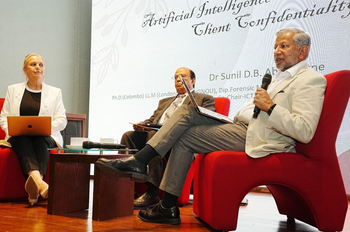
The symposium covered a wide and timely agenda, including alternative dispute resolution, professional ethics, children in the justice system, artificial intelligence, data protection, client confidentiality and environmental law. The range of topics reflected shared international challenges, while also showing how differently they can arise in particular legal, institutional and social settings. In my session on artificial intelligence (AI), we found that many of the ethical and judicial questions being discussed in Colombo are familiar to legal systems around the world.
Some of the most enjoyable sessions were with new entrants to the profession. Colin Aylott KC and I gained as much from the advocacy training as the young lawyers did from the practical exercises. We hope such training will become a regular feature of future visits and help strengthen the relationship between the two countries’ lawyers.
The symposium also showed why international engagement works best when it is reciprocal. We may bring experience from England and Wales, but we return with a better understanding of another jurisdiction and fresh perspectives on our own practice.
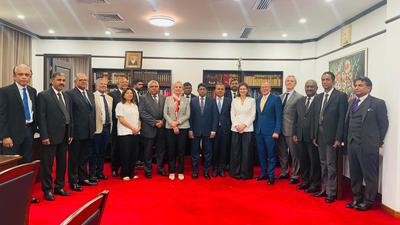
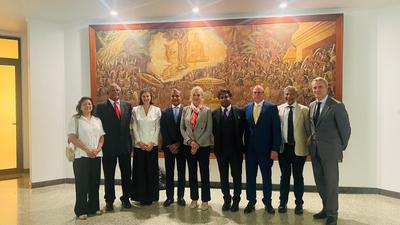
The programme also extended beyond the conference venue. The delegation visited the Supreme Court and Court of Appeal in Colombo, met senior members of Sri Lanka’s legal profession and judiciary, and took part in practical exchanges, including advocacy and mediation sessions. Andrew Miller KC spoke on mediation in commercial disputes and conducted a popular masterclass - a mock mediation for younger lawyers. Paul Mylvaganam and Colin Aylott KC spoke engagingly on deferred prosecution agreements.
That practical dimension was one of the trip’s great strengths. The discussions were thoughtful and collegial, with a shared commitment to the rule of law, judicial independence, effective dispute resolution and developing the next generation of advocates. Our Sri Lankan hosts made us feel exceptionally welcome.
For me, the Colombo visit was more than an opportunity to represent the Bar of England and Wales abroad. It was a chance to take part in, and learn from, an international conversation about legal practice, advocates’ responsibilities and the institutions that sustain justice. I hope it marks the beginning of a lasting and productive partnership.
Sailesh Mehta is a barrister at Red Lion Chambers. He was a founding member of the Bar Human Rights Committee and has previously served as an elected member of the Bar Council.