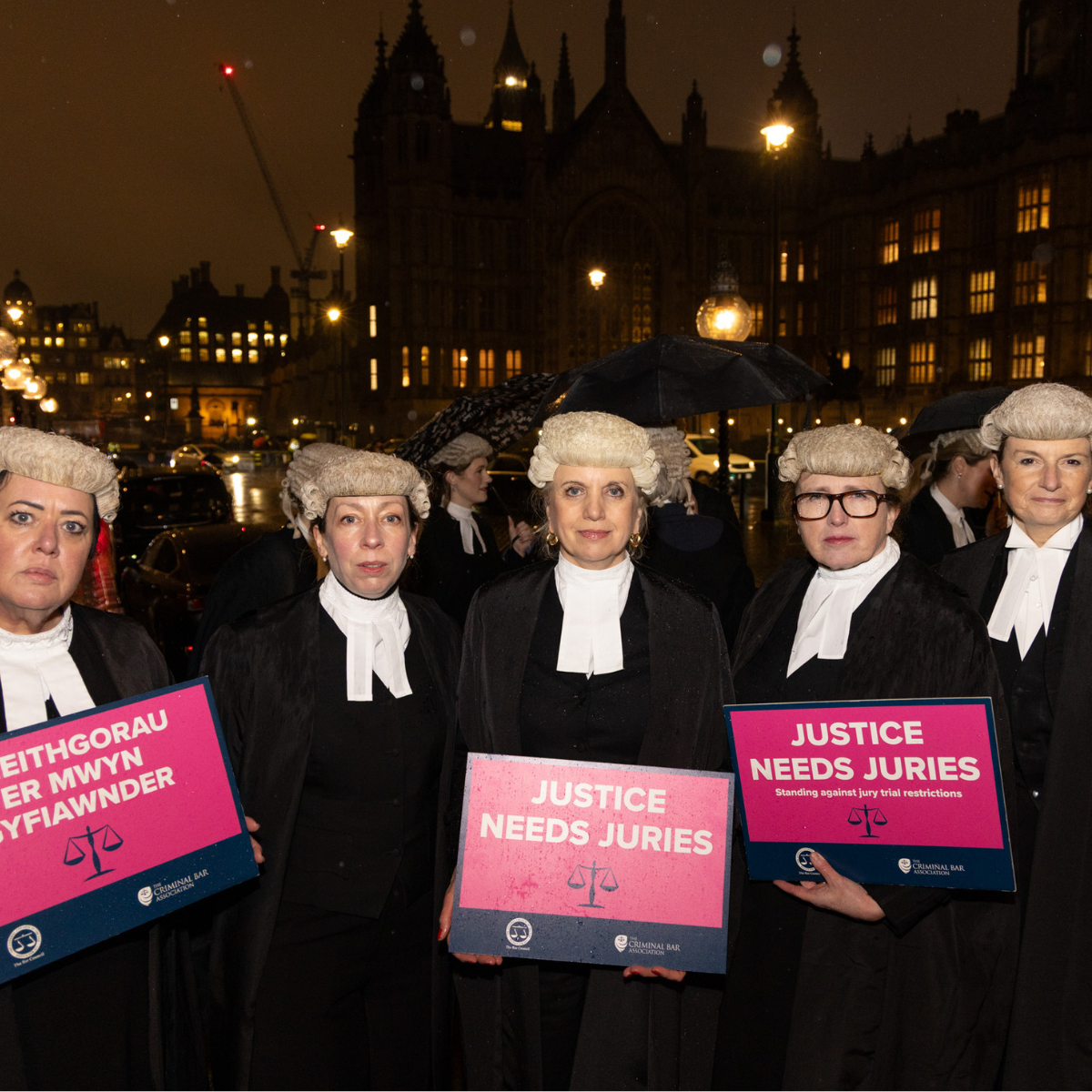
On 4 October the Lord Chancellor Alex Norris MP announced that the government would scrap plans to curb jury trials. He said: “I have heard the strength of feeling on the proposals for increasing the number of judge-alone trials in the Crown Court and have made the decision to change course.” In this blog, Chair of the Bar Council Kirsty Brimelow KC looks back at the ‘Justice needs juries’ campaign that led to that change of policy.
Late in 2025, when the then Lord Chancellor David Lammy MP announced the government’s response to the Leveson review of criminal courts, the seeds of the ‘Justice needs juries’ campaign were laid. In January the full campaign was launched.
We took our case to the government, Parliament and the public. On 7 January, MPs referred to our briefing in the Opposition Day Debate. On 12 January, resisting the government reduction of juries was my first priority as I set out in my inaugural speech before justice ministers.
We appeared before the Commons Justice Committee on access to justice and the Independent Review of the Criminal Courts Part 1.
By 26 January, our material was in circulation around MPs and peers and on 30 January we had organised Constituency Court Day – the start of MPs visiting courts with barristers and meeting barristers in robing rooms. We had a further coordinated day across all 6 circuits on 22 May and the Bar Council has worked with the circuit leaders to arrange visits throughout the year. For many MPs, seeing the courts and hearing directly from barristers has been a real eye opener.
The court visit I attended on 31 March 2026, arranged by the Bar Council and Midland Circuit, was at Nottingham Crown Court and the then Home Office minister in attendance was one Alex Norris MP, now Lord Chancellor and Secretary of State for Justice. He has spoken of how that visit impacted upon him. He heard from barristers in the robing room who identified delays and remedies and that none were due to juries. He saw for himself the crumbling infrastructure. Circuit Leader Harpreet Sandhu KC even ensured that he saw the state of the lavatories!
On 3 February, you came to our Parliamentary Lobby Day and stood in the rain in wigs and gowns to give a visual identity to our campaign and show the strength of feeling at the Bar.
From 12 February we started collecting our own data from barristers to evidence the delays in the Crown Courts caused by the late delivery of individuals in custody to court. These delays take place anywhere along the journey from the prison cell to the dock and may or may not be attributable to the service overseen by the prisoner escort custody service (PECS).
Whilst responding to the Courts and Tribunals Bill, we also garnered 3,236 signatures to our open letter to the Prime Minister, including over 300 KCs and 22 retired judges, setting out our principled and pragmatic objection to restriction of jury trials.
Throughout March we briefed MPs for the Bill’s second reading and I and circuit leaders (Samantha Hillas KC, Caroline Goodwin KC and Claire Davies KC) and Riel Karmy-Jones KC of the CBA gave evidence to the Public Bill Committee. We also submitted written evidence.
Working with the CBA and barristers from the Bar Council, we tabled 28 amendments to the Bill. Our amendments were mentioned at least 73 times during parliamentary debate.
Charlotte Nichols MP tabled an amendment to the Bill which was to set up a specialist rape and serious sexual offences and domestic abuse court, with a jury. I put the amendment forward in the evidence I gave to the Committee. It was rejected.
Our second Parliament Day was on 2 June, and we continued our MP letter campaign assisting barristers to write to their MP. On 16 July, our report on the late delivery of prisoners to court was published from over 200 reports from barristers at court. It revealed that over a quarter of the incidents involved delays of over 5 hours.
On 21 July, the Bar Council immediately engaged with the new Lord Chancellor, reiterating opposition to reducing jury trials. On 31 July I referred to Andy Burnham’s indication that his instincts were “not to reduce access to jury trials”. I had already written to him and instilled a bit of my own Northern bluntness.
On 21 September, the government announced that it would introduce a rape and serious sexual offences court and credited the “immense courage and bravery” of Charlotte Nichols MP, a description with which I wholeheartedly concur.
On 4 October 2026, the government announced that it will amend the Courts and Tribunals Bill to remove the clause (Clause 3) that removes trial by jury for those either-way offences where a Crown Court judge assessed the offence(s) to be tried likely to attract a custodial sentence of three years or less. Those cases were to be tried by a single judge (Crown Court Bench Division).
Success!
Thank you for every step you took – writing to your MP, signing our letter to the Prime Minister, talking to politicians in robing rooms and setting out the Bar’s opposition. Every interaction made the difference.
The fight goes on to ensure the government doesn’t remove the right to elect or increase magistrates’ sentencing powers. But for today we celebrate the government listening to the expertise and experience of the Bar.