Submit your report to the Commissioner for Conduct’s team
Alternatively, simply save your record on Talk to Spot as a contemporaneous note, and it goes no further. You can always revisit it later if you decide you do want to escalate it
Step 2: Commissioner for Conduct’s team reviews the report
We read your report, work out the issues and the possible next steps, and respond to you within 10 days.
Step 3: We explore your options with you
We will get back to you with your options, any support we think you might want and recommendations for next steps.
If you make an anonymous report, we can contact you via Talk to Spot without knowing your identity.
Step 4: We agree a way forward led by you – nothing is done without your agreement
You may decide not to take the issue any further or we can support you to raise a concern in chambers, your Inn, Specialist Bar Association or other. Alternatively, we can raise a concern on your behalf, or we can refer it to the BSB (if you wish and agree).
If you made a report about something that happened to you, or someone who has confided in you, any action we take will always be led by you (the reporter), and we don’t do anything without your agreement.
There may be times when we have to make a referral to the BSB but this is only when someone makes a report as a third party and isn’t the confidant, and in this situation we would speak to you before taking any action.
What will the Commissioner's team consider when advising on action?
Your wishes
The type and severity of the behaviour
The role or position of the perpetrator (as this may determine what the relevant regulator or responsible body is)
A barrister submits a record of an opposing barrister complimenting her appearance in a patronising way at the end of their case.
She says it made her uncomfortable.
She submits a report to the Commissioner for Conduct via Talk to Spot. Acknowledgement of receipt of the record is issued. The Commissioner for Conduct team will consider issues raised by the report. This incident is deemed potential sexual harassment but doesn’t meet the threshold of serious misconduct.
This conclusion was based on the following factors:
The barrister is not a member of the reporter’s chambers and there is no clear power imbalance, though he is more senior
The reporter was confident there wasn’t sexual intent
The behaviour wasn’t perceived as predatory (it was experienced as patronising and outdated)
There haven’t been other reports about the same barrister
The reporter is contacted by a member of the Commissioner’s team and her record and options for action are discussed. The reporter does not wish to make a formal complaint but does not want to be subjected to similar behaviour in future. The reporter requests we contact the barrister’s chambers and informally raise a concern over this type of behaviour. The Commissioner’s team contact the barrister’s chambers’ Equality Diversity Officer (EDO), explaining the situation. The EDO and Head of Chambers have an informal conversation with the barrister.
Yes. When you make a report via Talk to Spot, neither your email address, location, nor any other usage information is submitted to the Commissioner for Conduct. The Commissioner for Conduct's team won't know who you are, but they can still contact you through the platform.
Before submitting your report, you'll be able to edit your responses and remove details that may reveal who you are.
When we receive your report, we consider the type and severity of the behaviour and the role or position of the perpetrator. If the behaviour has clearly breached the threshold for serious misconduct, we’ll then ask for your permission to escalate it to the relevant body such as the Bar Standards Board (BSB) if the perpetrator is a barrister.
Only with your consent, we will transfer data as a report to the BSB or will advise you to refer to the BSB yourselves. The reporter may be advised that they haven’t met their reporting obligation if they decide not to report to the BSB where appropriate.
If you’re not sure about your reporting obligations email [email protected].
Yes. The BSB handbook now also includes serious instances of bullying as an example of serious misconduct. Serious instances of bullying are persistent, unwanted behaviour from a person or group that is either intimidating, malicious or insulting, or an abuse or misuse of power that undermines, humiliates, or causes physical or emotional harm to someone.
The BSB now allows reports of serious misconduct in relation to bullying and harassment to be made either to the Commissioner for Conduct or the BSB. Reports to the Commissioner can be made via Talk to Spot.
No. You are not under a duty to report serious misconduct in relation to bullying and harassment if someone has confided in you. The new status of a ‘confidant’ has been created.
If you’re not sure if you qualify as a confidant, you can speak in confidence to the Commissioner for Conduct team, either via Talk to Spot or email [email protected].
It’s important we’re able to protect people, so if you hear rumours or suspect something about someone, it’s better that you make a record with either the Commissioner for Conduct via Talk to Spot or alert the BSB. The BSB has lowered the threshold for third party reporting, so you don’t need evidence. Previously, the threshold was ‘reasonable belief’ now it is ‘reasonable suspicion’. No action or investigation can take place in the absence of evidence, but it’s important from a safeguarding perspective that reports are made where there’s reasonable suspicion it occurred.
Our comprehensive bullying and harassment training is for all barristers, clerks and chambers staff. We offer a range of courses to suit your needs and learning styles.
Posters for your chambers or workplace
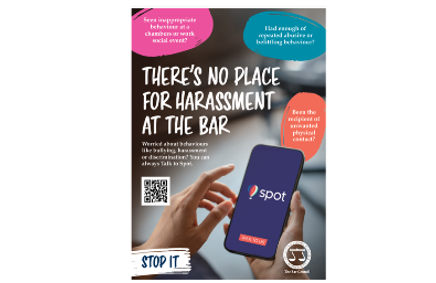
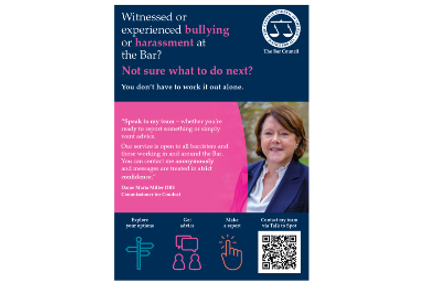
Download and print our posters so colleagues know where they can report and get support for incidents of harassment, abuse and other inappropriate behaviours.