
The clearest way to monitor how work is distributed at the self-employed Bar is to analyse the distribution of gross earnings by sex and practice area.
Through this analysis, we've identified that women earn less than men across all experience levels and practice areas at the self-employed Bar in England and Wales, and that Black women earn less than White women.
Median earnings of self-employed junior barristers by PQE band, 2025
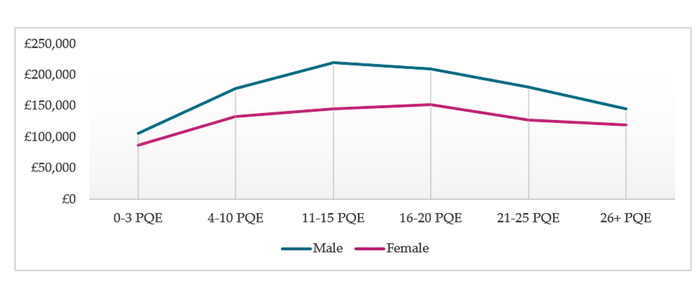
Our latest report on earnings by sex and practice area at the self-employed Bar found:
- Junior women’s median earnings were 74% of what junior men earn. Women silks’ median earnings were 69% of their male colleagues’ median gross earnings.
- Earnings gaps persist across every post-qualification experience (PQE) band. The highest earning men were consistently earning more than the highest earning women.
- There were earnings gaps in every area of practice. The widest gaps were in general civil practice, where women at 21-25 years PQE were earning 60% of their male colleagues’ median fee income.
- During the previous 5 years (2021-2025), median earnings at the Bar increased for both men and women. However, women’s earnings increased by less than men’s. This means the gap is still increasing.
We've identified the following trends:
- Gender earnings gaps exist from the beginning and widen over time and cannot be explained by periods of parental leave.
- There’s a strong gender balance at entry level but ongoing challenges in retention and progression
- Access to quality work is a key driver of career progression
- Women frequently undertake similar levels of work (ie it’s not down to part-time working) but can receive less lucrative instructions
In 2021, the Bar Council published its first Race at the Bar report, which included data on earnings which showed that, at all band levels, White male barristers earn the highest fee income. This is especially stark from the higher income bands. Asian/Asian British males earn the most after White male and female barristers. Black female barristers earn the least.
Our work to close the earnings gap

We want to close the earnings gaps across the Bar, working alongside the Institute of Barristers Clerks (IBC) and the Legal Practice Managers Association (LPMA), the Law Society and professional and lay clients, government, major law firms and FTSE350 companies.
We are also working with clients like the CPS and GLD, and individual specialist Bar associations to cut earnings data so they can better understand who gets what work by sex, by volume and by value.
We work closely with chambers to help them ensure every member has fair access to work. We have a series of policies, guidance and resources for chambers to use as well as helping chambers to audit earnings. We want barristers to feel informed about your practice and confident about discussing earnings/the type of work you want with your clerks. We also provide training on work distribution and monitoring to ensure a better understanding of how to monitor the distribution of work within chambers and find out how to generate data to inform practice management.
Our team has been commissioned (under confidential data sharing agreements) to help individual chambers understand the distribution of earnings in their set, explore emerging patterns and make recommendations for interventions. Contact us for more information about this.
6 actions you and your chambers should take:
- Monitor the profile (diversity) of your members (by PQE and specialism) and consider what action you are taking to ensure you have diverse, available, and qualified counsel to offer clients
- Monitor earnings (and tackle earnings gaps where identified)
- Have a fair access to work policy (that includes led work)
- Offer every member a practice review, and where possible (i) share comparable (anonymised) earnings data; and (ii) discuss practice development
- Support good practice in billing
- Let clients know if you are a signatory to any charter around work for example the Chancery Bar’s Charter for fairness
Equitable briefing practices are important in determining access to high value work, visibility and career progression at the Bar. The work individuals are given directly shapes career trajectories, influencing future opportunities, reputation and earnings over time.
Briefing practices remain largely informal and inconsistent, although challenging decisions, broadening networks and tracking patterns are beginning to drive change. It is not only a solicitor issue or chambers issue but a profession-wide issue, influenced by clients, firms/in-house teams, chambers and barristers.
We’re working with the Law Society, major law firms and clients to understand and address barriers to fair briefing. Some law firms and lay clients already ask clerks for mixed lists and want to know that those chambers they instruct regularly are developing diverse talent. We’re working with the Law Society, major law firms and clients to track developments in this area to make sure chambers know what clients expect.
Read more about our work with the Law Society
We’re supporting barristers and chambers to adopt good billing practice. This means ensuring you understand the value of your work, record and bill accurately, and have the information and support necessary to make informed commercial decisions about your practice – all proved to positively impact on earnings.
For example, one chief executive commercial barrister in a large chambers found time recording particularly effective. They said: “The biggest win for me was time recording... We saw an increase in 20% of turnover as a result of that. Because, as a sector, particularly at the Bar, we tend to undervalue the time we put into cases.”
If you’d like to get involved in our work to close the earnings gap at the self-employed Bar, contact us.
- Making work pay: why it’s important to monitor earnings by sex at the self-employed Bar blog
- Past earnings reports (Bar Council - 2025, 2024, 2023, 2022, 2021)
- New Practitioner earnings differentials at the self-employed Bar (Bar Council - 2024)
- Income at the Bar by Gender and Ethnicity (Bar Standards Board - 2025)